


How Much Should a Website Cost in 2026?
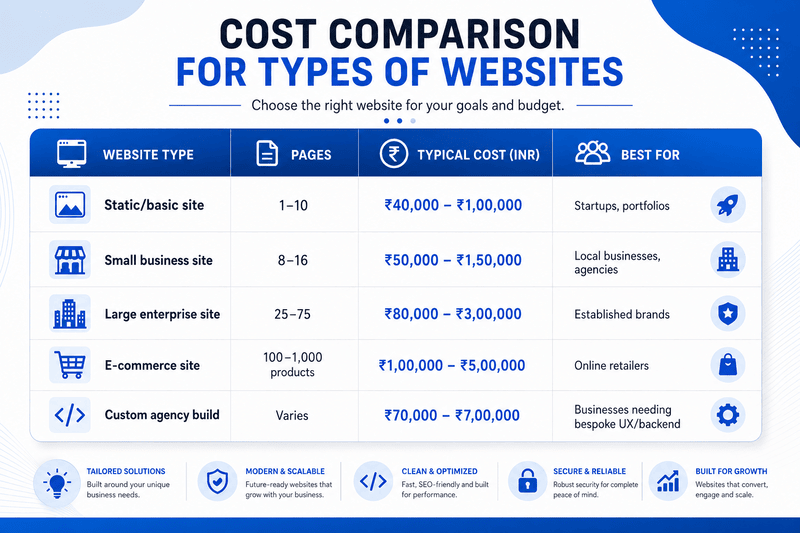
Ask five business owners around you what a website should cost, and you'll hear five drastically varied answers, from ₹8,000 to ₹5 lakh. Neither is technically lying. GoDaddy's 2026 India pricing for a basic 1-10 page website is between ₹40,000 to ₹1,00,000, while a suitable small company site with 8-16 pages is ₹50,000 to ₹1,50,000. In truth, there isn’t one number for “website cost.” It’s a spectrum that relies largely on what you’re actually doing and who’s building it. That uncertainty explains why so many business owners either overpay for a fancy-named template, or underpay and wind up with a site that discreetly costs them clients every month that it stays faulty.
What Does a Website Cost?
At its core, website price isn't a flat rate card, it's a collection of shifting factors. It usually consists of:
- Complexity of design (Template vs. Custom UI/UX)
- Content depth and pages number
- Backend functionalities (bookings, payment gateways, dashboards)
- Recurring hosting, domain & SSL charges
- Content writing and SEO configuration
- Maintenance and assistance post-launch
A five-page brochure site and a booking platform with a client login are both “websites” on paper, but they don’t belong in the same budget conversation. Typically, the space between them is where clients become surprised, not because anyone misled about pricing, but because no one properly specified the scope at the outset.
Why Companies Choose Custom Development Instead of DIY Builders
Many new businesses start with a drag-and-drop builder. That’s good for a weekend endeavor. But businesses that expect to expand tend to move out of it eventually. Working with a website designing company in Ludhiana pays dividends usually through instead of a builder template:
- Faster load times, no builder bloat
- Authentic design that speaks to the brand, not a template rehash
- Scalability to allow for future new features without a rebuild.
- Stronger technical SEO foundations from day one
- Total control of your code, hostings and integrations
That’s not to say DIY builders are awful – for a single-page portfolio, they’re typically the smarter choice. It's about aligning ambition to the instrument.
Cost Comparison for Types of Websites
But here’s what the numbers really look like for the most popular sorts of projects, based on existing India-wide benchmarks:
What’s Really Driving the Price Up (or Down)
Many clients feel design is the primary cost driver. It’s typically not the functionality. A website with contact form and blog is inexpensive. A site with real time inventory, customer dashboard and third party API interfaces is a whole different beast and that’s where website development cost in Ludhiana prices begin to fluctuate drastically amongst vendors.
- Custom animations and interactivity cost dev time
- Content cost increases with several content kinds (blog, case studies, resources)
- Payment gateway and booking integrations to test and security review
- More work for multilingual or multi-location material
- Recurring costs are ongoing SEO and maintenance, not one-time expenditures
Mittal Technologies Perspective: Businesses budget for the build and forget about maintenance all together. A site that is not updated, monitored and lightly optimized every few months will drop down ranks in a year and the initial outlay becomes a sunk cost. It’s worth seeing the folks who will be actually maintaining your site before you sign off on a price. Our team page is an excellent place to start.
The Website Development Process, Step by Step
Regardless of whether you are hiring a freelancer or a full-fledged website development company Ludhiana businesses trust, the approach should look essentially the same:
- Discovery call: learning about goals, target audience and competition
- Quote and scope: specifying timeframe, pages and features
- Wireframe and design: form before beauty
- Development: front-end build, backend logic
- Content and SEO configuration: copy, metadata, schema
- Testing: cross-browser, mobile and speed testing
- Go-live plus training on the CMS: launch and handover
There are economic implications to each of these phases and that’s why a quick two-day “quote” over WhatsApp is often a red signal, not a bargain.
Common Problems (and How to Actually Fix Them)
Scope creep is arguably the single biggest reason projects run over budget, "just one more page" adds up fast. Best Practice: Document the scope in writing before development begins and manage expansions as distinct change requests.
Another common problem is delayed load times caused by cheap hosting. A shared plan for ₹99/month can destroy months of SEO work. Best Practice: budget for hosting that fits your actual traffic, not the cheapest option on the shelf.
Businesses typically won't do SEO at launch thinking they'll "add it in later". Best Practice: bake in fundamental technical SEO (clean URLs, schema, meta tags, etc.) from day one, as retro-fitting it after-the-fact is nearly always more costly.
No maintenance plan, just a slow accumulation of faulty plugins and obsolete CMS versions until something breaks publicly. Best Practice: Budget 10-15% of build cost every year for maintenance and assess it quarterly rather than waiting for a crisis.
In our Zaffar Khan personal branding case study, we took a Ludhiana-based personal brand through exactly this kind of budgeting debate where the aim was not to spend more, but spend precisely on the things that actually moved the needle.
A limitation that should be honest
A well-built site alone will not rank or convert. The build is the foundation, not the finish line, it needs continual content, backlinks and technical maintenance. Any good IT company in Ludhiana would tell you this straight up, instead of letting the sales pitch imply that the website will alone do the job. If someone promises you page one rankings in the first month of launch, that's something to be wary of, not celebrate.
Where Costs of Websites Are Heading
- AI-assisted design technologies cut down construction schedules
- More focus on Core Web Vitals directly affects rankings
- More businesses budgeting for AI Overview exposure, not just SEO
- Expectations are rising for mobile first, near immediate load speeds
- Accessibility compliance is shifting from afterthought to routine line item
Summary
In 2026 there’s no such thing as a “right” number for a website, simply the correct number for what your firm truly requires. If you are comparing quotes from different IT company services in Ludhiana, make sure you acquire a documented scope of work before you ask for price, it changes the whole conversation and it's the one easiest approach to compare quotations fairly. When you’re ready to speak figures for your particular instance, you can reach out to us directly and we’ll guide you through a realistic budget vs a generic package.
FAQ
1. How much does a simple company website cost in Ludhiana?
Typically Rs. 40,000 to Rs. 1,50,000 depending on pages and functionality, based on current India wide development norms.
2. Is it worth a low cost website (less than ₹10,000)?
Maybe for a real landing page. If you have a business that needs reputation and SEO, the lost opportunity cost is frequently more than the savings.
3. Does SEO count toward website cost?
Usually SEO setup and continuous optimisation is usually billed separately from the build itself.
4. How often should you budget for website maintenance?
Hosting, updates and minor changes are about 10-15% of the original build cost per year.
5. Why do agency bids differ so much on the identical requirements?
The differences are mainly in the seniority of the team (including the rounds of revision), and whether SEO/content is packaged or charged for separately, therefore it is worth asking for a granular (item-by-item, not lump amount) breakdown before comparing quotations.