


How to Select the Right Social Media Platform for Your Business
Every second business owner I talk to wants to "be on Instagram" before they've even figured out where their actual customers spend time. I get the instinct, but it's usually backwards. According to Sprout Social's 2026 data, the average user now switches between nearly seven different platforms every month, and increasingly relies on social media for search and discovery, not just scrolling. That spread is exactly why picking the wrong platform for your business isn't a small mistake. It means your content, your budget, and your team's time are going somewhere your customers simply aren't.
This is the problem most businesses run into before they ever call a digital marketing company in Ludhiana. They start posting first and ask "is this working" months later, once the ad spend is already gone.
What Does "Choosing the Right Platform" Actually Mean?
Platform selection isn't about picking the trendiest app. It's about matching where your specific audience already spends time, what format suits your product or service, and what your team can realistically maintain. It usually comes down to:
- Who your audience is (age, profession, location, buying behavior)
- What you're selling (product, service, B2B, B2C)
- What content format fits naturally (photos, video, text, listings)
- How much time or budget you can commit weekly
- What your competitors are doing well or badly on each platform
Why Getting This Right Actually Matters for a Business
Businesses that choose deliberately rather than by trend tend to see:
- Higher engagement because content matches audience expectations
- Lower cost per lead, since ad spend isn't spread thin across irrelevant platforms
- Faster content production, because the team isn't stretched across five channels
- Better brand consistency, since messaging doesn't get diluted trying to please everyone
- Clearer attribution, so you actually know what's driving inquiries
This is usually where the difference between a generic freelancer and a proper digital marketing agency in Ludhiana shows up, since strategy work like this rarely happens when someone is juggling five other clients on the side.
Matching Platform to Business Type
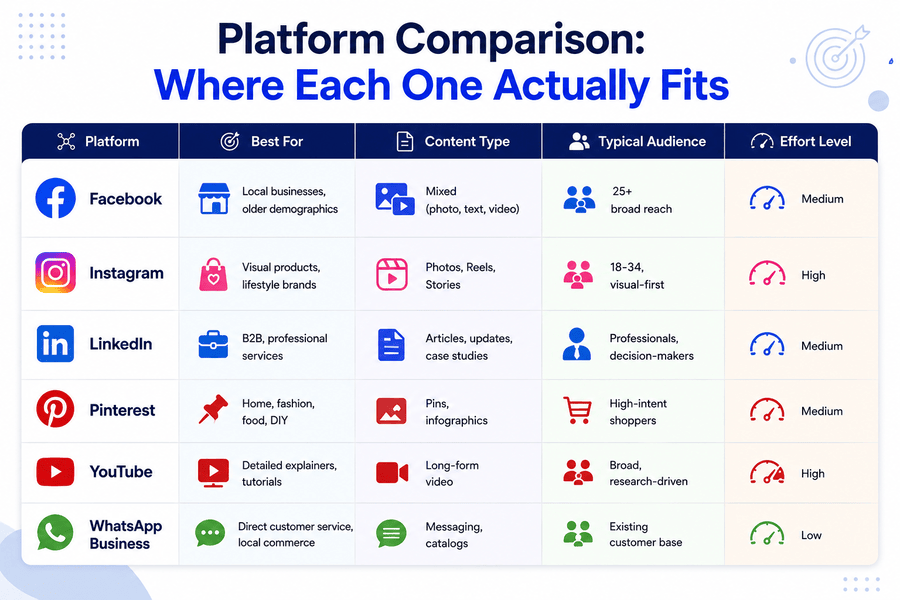
Local service businesses (salons, clinics, home services) usually do best starting with Facebook and Google Business Profile together, since Pew Research consistently finds Facebook has the broadest reach across older, local audiences.
- Post before/after work, customer reviews, and local offers
- Use Facebook groups for community-level visibility
- Keep response time fast, since local customers expect quick replies
- Pair with WhatsApp Business for direct booking conversations
B2B and professional services rarely need to be everywhere. LinkedIn alone, done consistently, usually outperforms a scattered five-platform approach.
- Share case studies and client outcomes, not generic tips
- Post from founder or team profiles, not just the company page
- Comment actively on industry conversations, don't just broadcast
- Use LinkedIn articles for long-form thought leadership
Mittal Technologies Insight: We've seen B2B clients cut their social media hours in half by dropping Instagram entirely and putting that same effort into LinkedIn. Fewer platforms, done properly, almost always beats more platforms done half-heartedly. This kind of platform-plus-content pairing works best alongside solid SEO services in Ludhiana, since organic search and social should be pulling the same audience toward the same message, not working against each other.
Visual and lifestyle brands (fashion, food, interiors) genuinely benefit from Instagram and Pinterest working together, since Pinterest users tend to be actively shopping, not just browsing.
- Use Reels for discovery, Stories for daily engagement
- Pin product photography with keyword-rich descriptions on Pinterest
- Collaborate with micro-influencers relevant to your niche
- Keep a consistent visual style so the feed reads as one brand
How to Actually Choose (Step by Step)
- Define your audience precisely — age, location, income bracket, and buying habits, not just "everyone"
- List where competitors are actually getting engagement, not just where they're posting
- Match platform strengths to your content capability — if you can't shoot video weekly, don't pick a video-first platform
- Start with one or two platforms, not five, and commit for at least 90 days before judging results
- Set a content cadence you can sustain — three consistent weekly posts beat seven inconsistent ones
- Track engagement and inquiries, not just followers — followers don't pay invoices
- Reassess quarterly and shift budget toward whatever platform is actually converting
Common Challenges (and How to Fix Them Properly)
Challenge: Trying to be active on every platform at once. Best Practice: Pick one primary platform based on audience data, and treat any second platform as secondary, not equal.
Challenge: Copy-pasting the same content across platforms. Best Practice: Reformat for each platform's native behavior — a LinkedIn post and an Instagram caption should never read the same.
Challenge: Chasing follower count instead of business outcomes. Best Practice: Track inquiries, calls, and conversions per platform, not vanity metrics.
Challenge: Abandoning a platform after a few weeks of low engagement. Best Practice: Give any platform at least 90 days of consistent posting before deciding it doesn't work.
Challenge: No one internally owns the strategy, so it drifts. Best Practice: Assign clear ownership, even if it's outsourced, so posting doesn't become reactive.
Where Businesses Often Get This Wrong
It's worth being honest here: platform popularity changes fast, and what worked two years ago on a given platform doesn't guarantee results today. Algorithms shift, audiences migrate, and a platform that was cheap to advertise on can get expensive within a year. There's no permanent right answer, only a right answer for your business right now, based on current data. This is also why businesses searching for the best digital marketing agency in Ludhiana should ask for a strategy reviewed quarterly, not one locked in for a year and forgotten. A good social media marketing agency will usually flag this shift on their own, before you even ask.
Measuring Whether You Chose Correctly
Business KPIs
- Cost per lead by platform
- Conversion rate from social traffic
- Customer inquiries or bookings attributed to social
- Repeat engagement from existing customers
Technical KPIs
- Engagement rate (likes, comments, shares relative to reach)
- Click-through rate to website or landing pages
- Follower growth rate versus industry benchmark
- Content reach and impressions trend over time
What's Changing Going Into 2027
- Social platforms are increasingly functioning as search engines, especially for younger users researching products
- Short-form video continues to outperform static content across nearly every platform
- Social commerce is growing fast enough that platform choice now affects direct sales, not just visibility
- Messaging apps like WhatsApp Business are becoming core sales channels, not just support tools
- Niche and community-based platforms are pulling attention away from the biggest five
- AI-generated content is flooding feeds, making authentic, specific content stand out more, not less
The Bottom Line
Picking the right platform isn't about following trends, it's about matching where your audience actually is with what your business can realistically sustain. Get that match right and everything downstream, engagement, leads, ROI, gets easier. If you're also comparing notes with the best SEO company in Ludhiana you're talking to, ask them to show their platform reasoning before their portfolio. Want a second opinion on where your business should actually be showing up? Our marketing team can walk you through it, or you can drop us a line and we'll take it from there.
FAQs
1. Do I need to be on every social media platform?
No. Most businesses see better results focusing on one or two platforms where their actual audience spends time, rather than spreading thin across five.
2. How long should I try a platform before deciding it's not working?
At least 90 days of consistent posting. Algorithms need time to learn your content, and audiences build trust gradually.
3. Is Instagram always the best choice for small businesses?
Not necessarily. It works well for visual, lifestyle-driven brands, but a B2B service business often gets better results from LinkedIn.
4. How do I know which platform my customers actually use?
Look at competitor engagement, run small test campaigns across two platforms, and track which one drives actual inquiries, not just likes.
5. Should I hire a social media marketing agency or manage it in-house?
It depends on your team's bandwidth. Many businesses start in-house and bring in a social media marketing agency in Ludhiana once consistency or strategy becomes hard to maintain internally.