


In-House Marketing Team vs. Digital Marketing Agency
Here’s a number that surprised me. The Association of National Advertisers (ANA) reported in its 2023 study that 82% of surveyed members had an in-house agency, up from 42% in 2008. Yet 92% of respondents with in-house agencies still worked with external agencies. The findings suggest that bringing marketing in-house doesn't necessarily mean ending agency partnerships. For most growing businesses, that question lands on someone’s desk the moment results stall, and the choice is between hiring staff and briefing a digital marketing company. Below is how I’d weigh it.
What Is the In-House vs Agency Decision?
It’s a choice about who runs your marketing day to day: employees on your payroll, an outside team on a contract, or a mix of both.
- In-house usually means your own marketers, plus the tools and training they need
- Agency means a team that brings its own specialists, processes and software
- Hybrid means staff own strategy and brand, while an agency handles specialist or high-volume work
Why Businesses Choose an Agency
Almost nobody picks an agency because they dislike hiring. They pick one because a single hire can’t cover SEO, paid media, content and design at once. Good digital marketing services put those skills in one place, and you pay for the scope you use.
- Faster start, since there’s no recruitment cycle
- Specialists across channels instead of one generalist
- Fresh outside perspective on stale campaigns
- Costs that scale up or down with the workload
- Benchmarks drawn from many accounts, not just yours
In-House Team vs Digital Marketing Agency: Side by Side
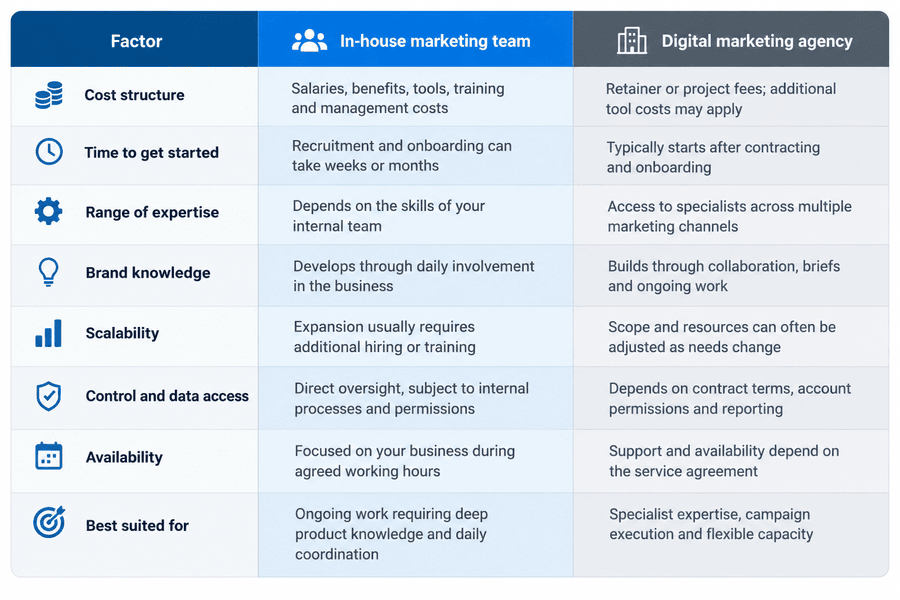
When an In-House Team Makes Sense
I’m not anti-employee. Some work simply belongs inside the company.
- Brand voice and positioning decisions
- Daily community management and customer replies
- Steady, high-volume content that needs constant product knowledge
- Ownership of first-party data. ANA’s report named this as a driver of bringing work in-house.
- Long-term planning that must stay close to sales and product teams
When a Digital Advertising Agency Is the Smarter Call
Paid media is the clearest example. A digital advertising agency runs campaigns across many accounts, so it spots platform changes and wasted spend sooner than one person working alone.
- Launching or rescuing paid campaigns on Google and Meta
- Technical SEO audits and site fixes
- Seasonal spikes that don’t justify a permanent hire
- Entering a new market where you have no local knowledge
- Short-term projects like a rebrand or a website relaunch
Mittal Technologies Insight: Before hiring your first marketer, write down the three jobs you’d want them to do in month one. If two of those need different specialist skills, an agency or a hybrid setup deserves a look first.
The Hybrid Model Most Brands End Up With
Given ANA’s 92% figure, hybrid is what mature teams actually run. It works when the split is clear.
- Staff own strategy, brand, budget and data
- The agency owns execution in specialist channels
- Both sides share one reporting dashboard
- A named person on your side manages the agency relationship
What Neither Option Can Fix
An honest caveat: ANA members are mostly large advertisers, and a 15-person business is a different animal. Cost efficiency, the main reason ANA respondents gave for going in-house, depends on steady work volume. Also:
- No agency rescues a weak product or unclear pricing
- No in-house hire fixes a missing strategy
- Neither option works without someone senior making decisions on your side
- Results in SEO and content take months, whoever does the work
Mittal Technologies Insight: If marketing results feel flat, check the offer and the website before changing who runs the campaigns.
How to Decide: A Six-Step Check
Whoever ends up on your shortlist, don’t let a search for the best digital marketing company make the call for you. Work through the decision like this instead:
- List every marketing task you’ll need over the next twelve months.
- Mark each as specialist work or steady daily work.
- Cost both sides honestly, including tools, training and management time.
- Pick three KPIs tied to leads or revenue, not impressions.
- Run a 90-day pilot with a tightly defined scope.
- Review the results, then move work in or out.
Challenges and Best Practices
- The agency doesn’t understand your business. Best Practice: share customer data, sales feedback and past campaign results in a written brief before work starts.
- A single marketer becomes the bottleneck. Best Practice: document processes and keep a backup option for critical channels.
- Reports full of vanity metrics. Best Practice: agree on KPIs in the contract and cut anything not linked to revenue or leads.
- Unclear ownership of accounts. Best Practice: ad accounts, analytics and domains stay registered in your company’s name.
- Hybrid friction over who does what. Best Practice: write down responsibilities and review them every quarter.
Where This Is Heading
- Hybrid setups becoming the norm. ANA expects in-house penetration to peak somewhere between 85 and 90 percent.
- More emphasis on owning first-party data, which pulls analysis closer to the company
- Automation handling routine reporting and bid adjustments, so strategy skills matter more
- Agencies shifting toward embedded specialists and outcome-linked contracts
Wrapping Up
In-house gives you depth and control. An agency gives you breadth and speed. Most businesses end up using both, so the useful question is which tasks belong where. If you’d like a second opinion on your setup, get in touch with our team and we’ll walk through it with you.
FAQs
1. Is an in-house marketing team cheaper than an agency?
It can be, but only when the workload is steady. ANA respondents cited cost efficiency as the main benefit, though they are mostly large advertisers. For a small business, one salary rarely covers SEO, paid media, content and design.
2. When should a small business hire an agency?
When you need several specialist skills at once, want to start quickly, or can’t justify a full-time hire for the workload.
3. Can a business use both an in-house team and an agency?
Yes. ANA found that 92% of members with an in-house agency also work with external agencies.
4. How long does an agency take to show results?
It varies by channel. Paid campaigns can produce data within weeks, while SEO and content generally need several months.
5. What should an agency contract include?
Ownership of ad accounts and data, agreed KPIs, reporting frequency, scope of work and a clear notice period.