


Landing Page Design Mistakes That Reduce Conversions
Unbounce analysed more than 41,000 landing pages, 464 million pageviews, and 57 million conversions in its conversion benchmark research (source: Unbounce). The median landing page conversion rate across industries was 6.6%. That figure is a useful baseline, but it also shows why landing page performance deserves attention. If you're sending paid traffic, email clicks, or organic visitors to a page, design and usability can directly influence what happens next. A landing page isn't a digital brochure. It is a focused conversion experience, and its design should support the wider goals of your website design & development rather than simply look polished.
What Are Landing Page Design Mistakes?
Landing page design mistakes are the layout, content, and technical decisions that stop an interested visitor from taking action — even when the traffic, offer, and targeting are all solid. They usually fall into a few buckets:
- Visual clutter that buries the actual offer
- Calls-to-action that are vague, buried, or repeated without variation
- Slow load times or a broken mobile layout
- Forms that ask for too much, too soon
- Missing or weak proof (no reviews, no numbers, no case studies)
Why Landing Page Optimisation Matters
Before spending more on traffic, it can make sense to improve the page that existing visitors are already reaching:
- Lower cost per acquisition, since existing traffic converts better
- Faster return on ad spend without touching the media budget
- Better landing page experience that can contribute to stronger Google Ads performance
- Cleaner data for future testing, because you're not guessing why people leave
For businesses working with a website designing agency, improving an existing landing page can often be more practical than rebuilding the entire website. A focused optimization can address specific issues with messaging, layout, usability, or conversion flow while preserving what is already working.
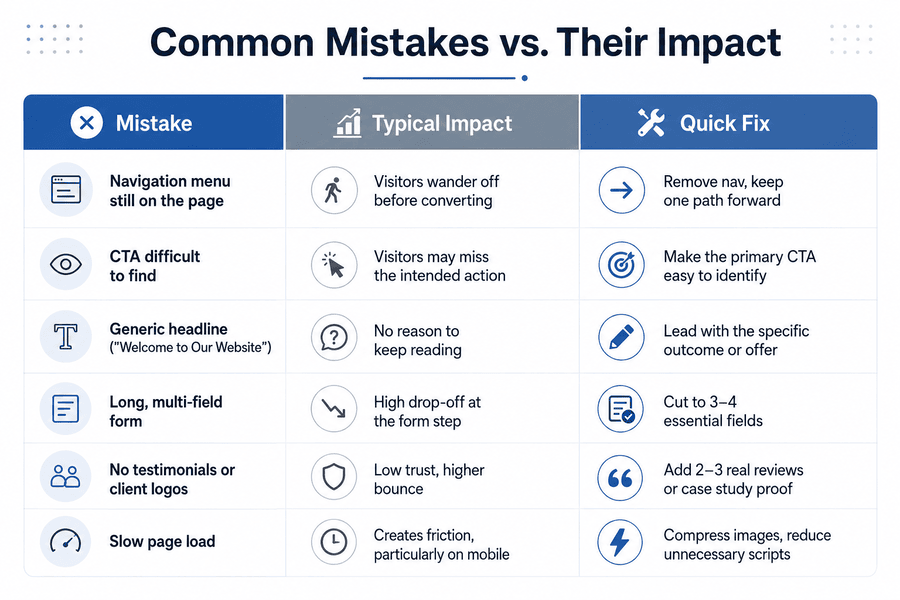
Cluttered Layouts and Weak Calls-to-Action
Good landing page design should support the wider goals of effective web design & development services. The page needs to communicate the offer clearly, minimise distractions, and guide visitors towards one specific action without making them search for what to do next.
- Stick to a single primary goal per page
- Repeat the same CTA text, don't rotate wording mid-page
- Remove secondary navigation links entirely
- Use contrast, not size, to make the button stand out
- Make the value proposition and primary action easy to find
Mittal Technologies Insight: on a recent automotive platform rebuild, we found through a client project that trimming the homepage down to one clear action improved form completions noticeably within the first month — no extra ad spend involved.
Slow Load Times and Poor Mobile Experience
Visitors may access landing pages from different devices and network conditions, making mobile performance an important part of modern website design. A professional web design agency should account for these conditions during both design and development.
- Compress hero images instead of uploading raw exports
- Avoid heavy sliders and auto-playing video backgrounds
- Test the page on an actual mid-range Android phone, not just a laptop
- Keep font sizes and tap targets large enough for thumbs
- Check Core Web Vitals in Google Search Console monthly
Confusing or Overloaded Forms
Every unnecessary field adds another point of friction to the form. We've seen businesses ask for company size, budget range, and a phone number before the visitor has even decided they trust the brand.
- Ask only for what you need to make the first call
- Use a single-step form over a multi-page one where possible
- Add a privacy microcopy line near the submit button
- Avoid CAPTCHA unless spam is a genuine problem
- Test autofill compatibility on mobile browsers
Missing Trust Signals
People buy from businesses they believe are real and reliable, and a landing page with no faces, no numbers, and no proof reads as generic — even if the business behind it is excellent.
- Add client logos or recognizable project names
- Include a specific number (projects delivered, years active, response time)
- Feature a short, named testimonial rather than a vague quote
- Link to a case study instead of just claiming expertise
- Show a real person or team photo where it fits naturally
How to Fix an Underperforming Landing Page
- Review conversion data in GA4 or your CRM alongside search performance data from Google Search Console
- Watch 5–10 session recordings to see where visitors hesitate or leave
- Rewrite the headline around the specific outcome, not the company name
- Cut the page down to one CTA and remove navigation distractions
- Compress images and re-test mobile load speed
- Add relevant proof, such as a customer review, credible statistic, or case study
- Run an A/B test long enough to collect meaningful data before choosing a winner.
These improvements should be considered alongside the wider website structure, especially when landing page performance is part of a larger web design project.
If this feels like more than your team has time for, it's usually faster to have someone audit the page directly than to keep guessing at fixes one at a time.
Real Challenges Businesses Run Into
- Design team wants creativity, marketing wants conversions. Best Practice: agree on one measurable goal before design starts, not after.
- Stakeholders keep adding "just one more section." Best Practice: set a clear page objective and remove sections that don't support it.
- No baseline data before the redesign. Best Practice: capture baseline conversion and engagement data before making major changes.
- Mobile is treated as an afterthought. Best Practice: design mobile-first, then adapt up to desktop.
- Nobody owns testing after launch. Best Practice: assign one person to review performance monthly, not "eventually."
Where This Is Heading
- AI-assisted personalization is starting to change CTAs and headlines based on traffic source
- Page length is becoming less about a fixed rule and more about matching the amount of information to the visitor's intent.
- Video testimonials and demonstrations are becoming another way to strengthen trust and explain products.
- Search experiences increasingly reward clear, direct answers that make key information easy to understand.
- Privacy-first tracking is forcing simpler, less invasive forms
Wrapping Up
Whether you're improving one campaign page or planning a complete website redesign, the right web design partner should look beyond visual appearance and consider usability, performance, SEO, and conversion goals. When comparing options, the best website design company is the one that understands your audience, business objectives, and the role your website needs to play in generating results.
Not every conversion problem starts with traffic. When relevant visitors are reaching a page but failing to take action, the landing page itself deserves closer attention. Improving clarity, usability, trust, and performance can be a more sensible first step than simply buying more traffic. If you'd rather have a second pair of eyes on it, our design team can identify the design and usability issues that may be limiting its performance.
FAQs
Q1. How much does professional landing page design typically cost?
Web designing services cost varies by scope, but a focused, conversion-tested landing page usually costs less than a full website rebuild and pays for itself faster.
Q2. How long should a landing page redesign take?
The timeline depends on the page complexity, research, content, design revisions, development, and testing required. A focused landing page can usually be completed faster than a broader website redesign.
Q3. Is a custom-built page always better than a template?
Not always — a well-optimized template can outperform a poorly planned custom build. Strategy matters more than the build method.
Q4. How do I know if my landing page is actually the problem?
Compare traffic sources, visitor intent, engagement, and conversion data. If relevant visitors are reaching the page but few are taking action, the landing page experience should be investigated alongside the traffic and offer.
Q5. Should every product or service have its own landing page?
Not necessarily. Separate landing pages can be useful when different services, products, audiences, or campaigns have different intent. A shared page can still work when the audience and offer are closely aligned.