


Web Development vs Web Design: What's the Difference?
A business owner told me once that she'd hired "a web guy" to build her site, and three months later she still didn't have a working shopping cart. Turns out her guy was a designer — great with colours and layout, but he'd never written a line of JavaScript in his life. Nobody had explained the difference before she signed the invoice.
This mix-up happens more often than you'd think, and it's not cheap. Google's own research, published in its "Need for Mobile Speed" study, found that 53% of mobile visitors abandon a site that takes longer than three seconds to load — a problem that sits on the development side, not design. If you're evaluating web design and development services, knowing which half of the job does what will save you time and a fair amount of frustration.
What Is Web Design?
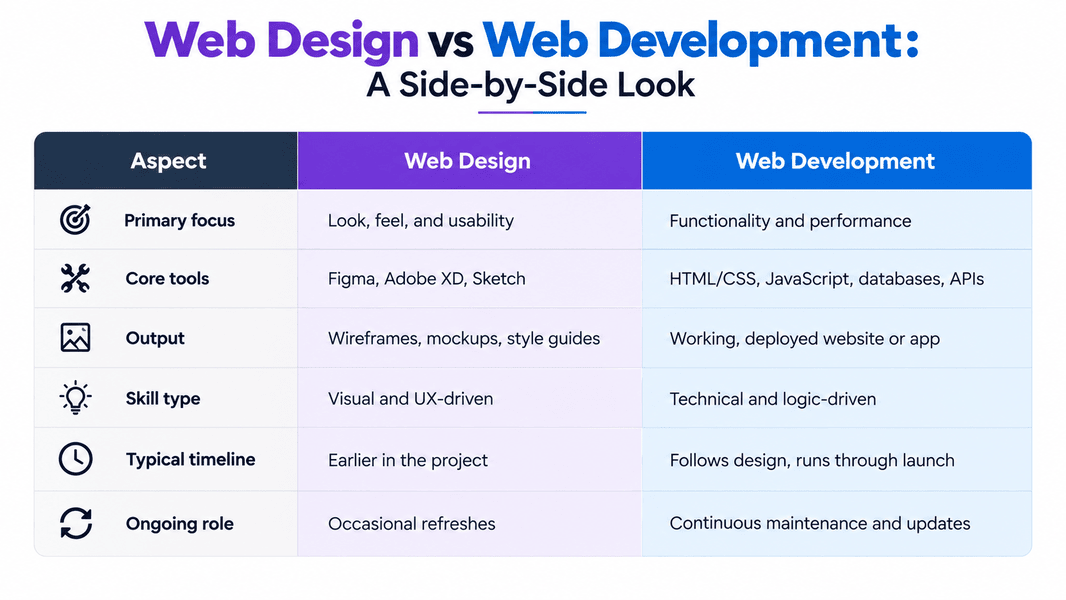
Web design is the visual and experiential layer of a website — what people see and how it feels to click around. A designer decides where the eye should land first, whether a button reads as "click me" or gets ignored, and how the brand's personality comes through in colour and type.
Web design typically includes:
- Layout and visual hierarchy
- Colour palettes and typography
- User experience (UX) and user interface (UI) planning
- Wireframes and interactive prototypes
- Responsive design across devices
What Is Web Development?
Web development is the engineering behind that design — the part that actually makes buttons work, forms submit, and pages load. Developers take a static design file and turn it into a functioning, secure, and fast website or application.
Web development typically includes:
- Front-end coding (HTML, CSS, JavaScript, frameworks like React)
- Back-end logic, databases, and server configuration
- API integrations and third-party tools
- Site security, performance, and hosting setup
- Testing and quality assurance before launch
Why Businesses Need Both, Not Either
Most companies don't need to pick a side — they need both skill sets working together. A beautifully designed site with sluggish load times will bleed visitors, and a fast, bulletproof site with a confusing layout won't convert anyone once they arrive.
- A cohesive brand experience that builds trust in the first five seconds
- Faster page speeds that reduce bounce rate and support SEO
- Fewer post-launch bugs because design and code were planned together
- Scalable architecture that doesn't need rebuilding every time the business grows
- Better conversion rates from forms, checkouts, and calls to action that actually work
Choosing Between a Designer, a Developer, or an Agency
This is usually where founders get stuck, since the right answer depends on the stage the business is at.
- A solo freelance designer works fine for a simple portfolio or one-page site
- A solo developer makes sense if the design already exists and just needs to be built
- An in-house team suits companies with constant, ongoing website changes
- A full-service agency fits businesses that want design and development handled under one roof, with one point of accountability
If you want both sides handled without managing two separate vendors, it can make sense to work with a web development company that keeps designers and developers on the same team. This helps reduce the gaps that can occur when a Figma design is handed over to a separate development team. Many businesses initially look for web design services, only to realise partway through the project that they also need development support to turn those designs into a functional website.
Mittal Technologies Insight: We've seen projects stall for weeks simply because a freelance designer and a freelance developer couldn't agree on file formats or spacing units. Keeping both disciplines under one roof, with shared documentation from day one, removes that entire category of delay.
The Real-World Process: From Idea to Live Site
- Discovery — understand the business goals, audience, and competitors
- Wireframing — map out the structure and user flow before any visual polish
- Visual design — apply branding, colour, typography, and imagery
- Front-end development — turn the approved design into working code
- Back-end development — build the logic, database, and integrations behind it
- Testing — check speed, security, cross-browser behaviour, and mobile responsiveness
- Launch and monitoring — go live, then track real user behaviour and fix what the data shows
We roughly followed this sequence while building the website for Threadss, an eCommerce platform. However, the design and catalogue logic had to be worked out together rather than handled as separate stages, because the product filtering directly influenced the page layout and user experience.
Common Challenges (and How to Actually Fix Them)
Design and development don't always meet in the middle smoothly. Here's where it usually breaks down:
- Designers create mockups developers can't build. Best Practice: involve a developer during the design review, before files are finalised, not after.
- Sites look great on desktop but fall apart on mobile. Best Practice: design mobile-first, then scale up, since most traffic arrives on a phone.
- Slow load times undo good design work. Best Practice: compress images and lazy-load anything below the fold before launch, not as an afterthought.
- Scope creep between "just a small design tweak" and a full rebuild. Best Practice: lock the wireframe and get a written sign-off before development starts.
- No one owns post-launch maintenance. Best Practice: assign an owner and a monthly check-in from day one, even if it's just 30 minutes.
None of these are exotic problems — they're the same five things that derail most website projects, and they're avoidable with upfront discipline rather than a bigger budget.
Where This Is Heading
- AI-assisted design tools are speeding up wireframing, though human judgment still decides what actually ships
- Accessibility (WCAG compliance) is shifting from a nice-to-have to a baseline expectation, partly due to legal pressure
- Headless architecture is separating front-end design from back-end systems, giving more flexibility to update either side independently
- Motion and micro-interactions are becoming a standard part of UX, not just decoration
- Sustainability-conscious development (lighter code, fewer server calls) is starting to factor into how sites are built
Bringing It Together
Design and development aren't competing disciplines — they're two halves of the same job, and a site built without both working in sync usually shows it, whether through slow load times or a confusing layout. If you're planning a new site or rebuilding an old one, it's worth talking to a team that can walk you through both sides before you commit to either.
FAQs
1. Is web design part of web development?
No, they're distinct disciplines, though they overlap closely. Design shapes how a site looks and feels; development builds the working product behind it.
2. Do I need a designer and a developer, or can one person do both?
Some freelancers do both competently on smaller projects, but as complexity grows, most businesses get better results from specialists working together, or an agency that keeps both under one roof.
3. Which comes first, design or development?
Design typically comes first so the structure and visuals are agreed on, but developers should be consulted early to flag anything that's difficult or expensive to build.
4. How much do web design services cost compared to development?
It varies widely by project scope, but development is often the larger line item since it includes ongoing logic, integrations, and testing that design work doesn't touch.
5. Can I redesign my site without touching the development?
Sometimes, if the underlying code and database structure don't need to change. But a significant visual overhaul often does require development work to implement correctly.