


Can AI Build a Website in 1 Hour? What AI Can Really Do
A decent chunk of small businesses have already jumped on the AI bandwagon for building their web presence — Hostinger's 2026 data puts generative AI adoption among small businesses at 58%, up from just 23% in 2023. That's not a niche trend anymore. But here's the question nobody's answering honestly: if you're actually running a business and not just testing a toy, is a one-hour AI website good enough, or does it just look good enough for the first five minutes someone spends on it? Working with an AI website development company day in and day out, I can tell you the honest answer sits somewhere in between, and it depends entirely on what you're building the site to do.
What Is an AI-Built Website?
An AI-built website is exactly what it sounds like, a site where artificial intelligence handles most of the heavy lifting that used to require a designer, a developer, and a few rounds of back-and-forth emails. You type a prompt or description of your business, and the tool spits out a layout, copy, images, and sometimes even basic SEO settings.
What it typically includes:
- Auto-generated page structure and navigation based on your industry
- Draft copy pulled from prompts or business descriptions
- Stock or AI-generated imagery matched to your brand tone
- Pre-set mobile responsiveness and basic on-page SEO
- Minimal-to-no coding required from the user
Why Businesses Are Turning to AI Website Builders
Speed is the obvious draw, but it's not the only one. Elementor's 2026 research suggests AI tools can cut the initial wireframing and design phase by 60-80%, significantly reducing the time needed to move from a blank canvas to a working website draft. That kind of shift changes who can even attempt a website in the first place.
- Founders without design budgets can launch something presentable fast
- Small teams skip the back-and-forth of briefing a freelancer
- Businesses testing a new idea get a landing page without committing real money
- Non-technical owners retain some control over edits later
- Lower upfront cost compared to a fully custom build
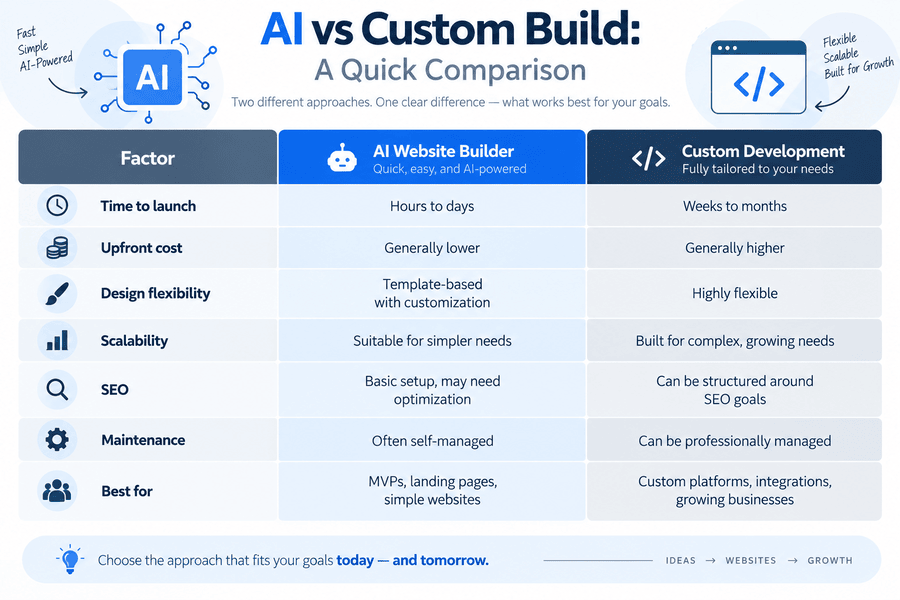
Where AI Genuinely Helps, And Where It Doesn't
I'll say this plainly because clients ask me constantly: AI is genuinely useful for getting a first draft out fast. It's not so useful once your business needs something the template wasn't built for.
- Great for MVPs, portfolios, and single-service landing pages
- Weak on custom functionality like booking systems, complex checkouts, or integrations
- Copy usually needs a human pass, it reads generic otherwise
- SEO structure is basic and rarely built around real keyword intent
- Design starts to look interchangeable once you've seen a dozen AI sites in the same niche
Mittal Technologies Insight: We've seen businesses come to us after launching AI-built websites that looked polished but struggled to convert. In several cases, the issue wasn't the technology itself; it was that the content, user journey and page structure weren't aligned with actual buyer intent.
When AI Website Builders Aren't Enough
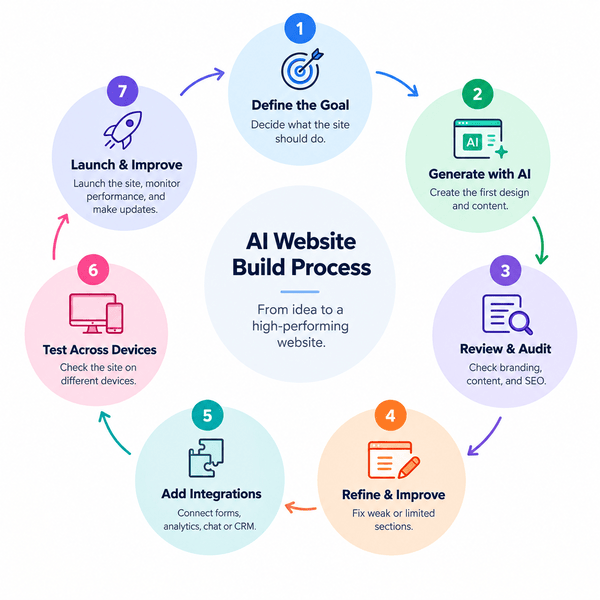
This is where the conversation usually shifts. Once a business outgrows the template, the smarter move isn't ditching AI altogether — it's bringing in one of the AI-powered web development services to layer real functionality, custom design, and structured SEO on top of what AI already got started. Think chatbots that actually route leads, personalization engines, or automated content workflows built into a custom-coded foundation.
- Combines AI's speed with human-led strategy
- Adds functionality templates can't handle (CRM syncs, custom dashboards, automation)
- Fixes SEO gaps left behind by generic AI output
- Keeps the brand voice consistent instead of sounding templated
Challenges Nobody Mentions Upfront
- Generic-sounding copy — Best Practice: always run a human editorial pass before publishing anything AI drafted.
- SEO that looks fine but underperforms — Best Practice: audit keyword intent manually; don't trust auto-generated meta tags blindly.
- Design sameness across competitors — Best Practice: customize visual elements even if the base template stays.
- Limited scalability for growing catalogs or services — Best Practice: plan for a custom rebuild before you hit that ceiling, not after.
- Weak accessibility compliance — Best Practice: manually check contrast, alt text, and navigation for screen readers.
- Data and privacy gaps in third-party AI tools — Best Practice: review what data the builder stores and where.
AI Tools Commonly Used in Website Builds
Wix ADI, Hostinger AI Builder, Emergent and 10Web are among the more widely used platforms right now, each handling layout generation, copywriting assistance, and basic SEO setup slightly differently. These tools can handle increasingly sophisticated builds, but the level of human involvement still depends on the site's functionality, integrations, performance requirements, and long-term goals.
Where This Is Headed
- AI-generated sites will get better at matching brand tone instead of sounding uniform
- Expect deeper integration between AI builders and real CRM/analytics tools
- SEO automation will improve but still need human oversight for competitive niches
- More businesses will use AI for the first draft, then hire developers for the build-out
- Accessibility compliance will likely become a built-in feature, not an afterthought
- Hybrid workflows — AI plus custom development — will become the norm rather than the exception
Final Thought
AI can absolutely get a website live in an hour, and for a lot of early-stage businesses, that's genuinely valuable. But "live" and "working the way your business actually needs it to" aren't always the same thing. If you're past the MVP stage, it's worth a conversation with our team about what a hybrid approach could look like for your site.
FAQs
1. Can AI really build a full website in an hour?
Yes, for basic layouts and single-purpose pages. Complex sites with custom functionality still take longer, AI or not.
2. Is an AI-built website good enough for SEO?
It covers the basics, but competitive rankings usually need manual keyword strategy and content structure beyond what templates generate.
3. When should a business move from AI to custom development?
Once the site needs functionality, templates can't support — custom integrations, scalable catalogs, or unique user flows.
4. Do AI website builders handle mobile responsiveness well?
Yes, mostly. AI website builders automatically create responsive layouts, but unusual designs and edge cases may still need manual adjustments for a consistent mobile experience.
5. Is it worth hiring a developer if I already used AI to build my site?
Often, yes — especially if you're past the testing phase. Reach out through our contact page if you want an honest read on whether your current site needs that step.