


Custom Software Development Trends to Watch in 2027
Stack Overflow's 2025 Developer Survey found that 84% of developers use or plan to use AI tools, up from 76% in 2024, yet 46% say they don't trust the accuracy of the output. Adoption is racing ahead of confidence. That gap is the story of 2027. Any business hiring a custom software development company right now has to decide how much of the build it wants machines to touch, and who is accountable when something breaks. This post covers the trends that matter and the ones that are mostly noise.
What Is Custom Software Development?
It means building software around how your business actually works, rather than bending your processes to fit a packaged tool. Teams usually choose it for:
- Internal platforms such as CRMs, ERPs, and workflow systems
- Customer-facing web and mobile apps
- Integrations between tools that were never designed to talk to each other
- Reporting dashboards built on your own data
Why Businesses Choose a Custom Software Development Company
Most clients don't come to us wanting "custom." They come tired of workarounds. The outcomes they want are fairly consistent:
- Fewer manual handoffs between teams
- Full ownership of code, data, and roadmap
- Software that scales without per-seat pricing surprises
- Security controls that match their industry, not a vendor's defaults
A good custom software development company earns its fee by asking uncomfortable questions before a single line is written.
AI-Built vs Custom-Built: A Plain Comparison
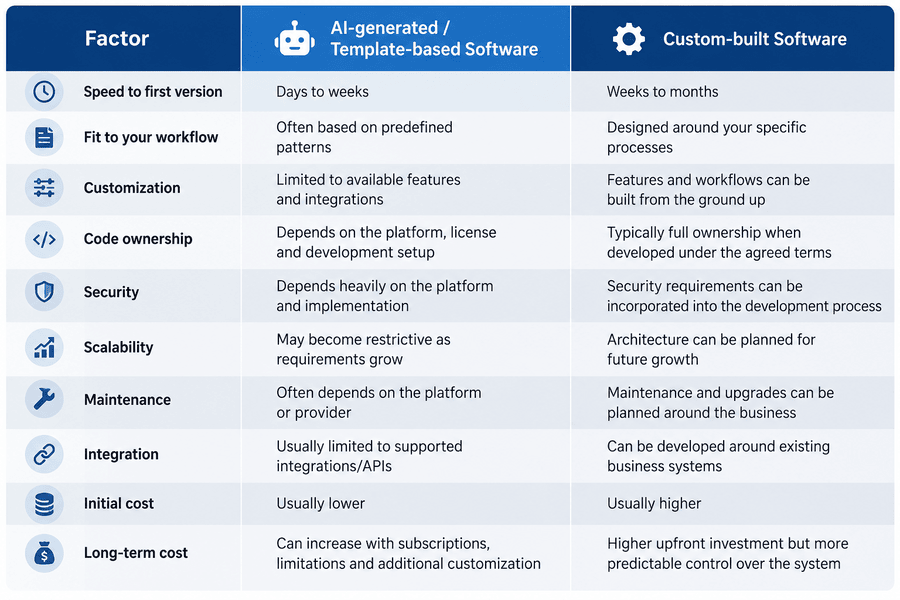
Neither column is wrong. A prototype for an internal pitch? AI scaffolding is fine. A system that handles payments or patient data? Different conversation.
Where Software Development Services Are Heading with AI
AI assistants are now normal in engineering teams, but "normal" doesn't mean "unsupervised." The same survey found the top frustration was answers that are almost right but need time-consuming debugging. Realistic uses we see:
- Drafting boilerplate and unit tests that a developer then reviews
- Summarising legacy code before a rewrite
- Generating first-pass documentation
- Flagging obvious bugs during code review
- Speeding up migration scripts
Mittal Technologies Insight: Treat AI output like a junior developer's pull request. Useful, fast, and never merged without a senior reading it.
API-First and Composable Architecture
Monoliths aren't dead, but more teams are building in modules that can be swapped without rewrites. It's less glamorous than AI and probably more valuable.
- Separate payment, auth, and notification services
- Connect to existing ERP or accounting tools through clean APIs
- Replace one module without freezing the whole product
- Let mobile and web apps share the same backend
- Make third-party integrations less painful to maintain
Security Moves to Sprint One
Security used to be a final-week checklist. It's now a design input, partly because clients ask harder questions and partly because dependency attacks are real.
- Dependency scanning on every commit
- Role-based access designed before screens are
- Secrets kept out of repositories
- Audit logs for sensitive actions
- Regular penetration tests, not annual ones
Mittal Technologies Insight: If a vendor can't explain how they handle dependency risk in one paragraph, keep looking.
Cloud Cost Discipline
Cloud bills have become a board-level topic. Expect more projects to include cost reviews as a deliverable.
- Right-sizing servers after launch data comes in
- Auto-scaling rules tied to real traffic patterns
- Cost tagging by feature or client
- Removing idle environments
- Choosing managed services only where they save engineering hours
Some of this shows up in bespoke software projects, where architecture choices are made around a client's real usage rather than a generic template.
How a Typical Build Runs
- Discovery workshop to define the problem and the people affected
- Scope and prioritisation, with a clear "not now" list
- Architecture and design sign-off
- Iterative development in two-week sprints
- Testing, security review, and user acceptance
- Launch, monitoring, and a planned support window
Strong software development services make steps one and two feel almost boring. That's a good sign.
Challenges Worth Being Honest About
- Scope creep. Best Practice: lock a change-request process in week one and price changes openly.
- Over-trusting AI code. Best Practice: mandatory human review and automated tests before merging.
- Hidden integration costs. Best Practice: audit every third-party system early, including its rate limits and documentation quality.
- Developer turnover on the client side. Best Practice: keep documentation current so knowledge doesn't live in one head.
- Underestimating maintenance. Best Practice: budget 15-20% of build cost per year for upkeep, and treat it as normal.
Custom software also isn't always the answer. If an off-the-shelf tool covers 90% of your needs, buying it is the smarter move.
AI Tools Teams Are Using in Builds
- GitHub Copilot and Cursor for code assistance
- SonarQube for static code analysis
- Snyk for dependency vulnerability checks
- Postman for API testing
Tools change fast. The review process around them shouldn't.
Future Trends Worth Tracking
- AI agents handling routine ticket triage and test generation
- Smaller, domain-specific models running inside company infrastructure
- Wider adoption of platform engineering teams
- Stricter data residency expectations across markets
- Software contracts that include AI-use disclosure
Conclusion
The businesses that get the most from custom software in 2027 will be the ones that stay curious about AI without handing it the keys. If you're weighing a build, get in touch with our team and we'll tell you honestly whether custom is the right call.
FAQs
1. What is custom software development?
It's designing and building software specifically for one organisation's workflows, rather than adapting a generic product.
2. How long does a custom software project take?
Small tools can take 8-12 weeks. Larger platforms often run six months or more, depending on integrations and compliance needs.
3. Is custom software more expensive than off-the-shelf?
Usually yes upfront. Over three to five years the gap often narrows once licence fees, workarounds, and limits are counted.
4. Will AI replace software developers?
Not on current evidence. Surveys show developers still verify AI output, and most don't use it for deployment or monitoring.
5. How do I choose a software development company?
Ask for relevant case studies, a clear security process, and named people who'll work on your project.