

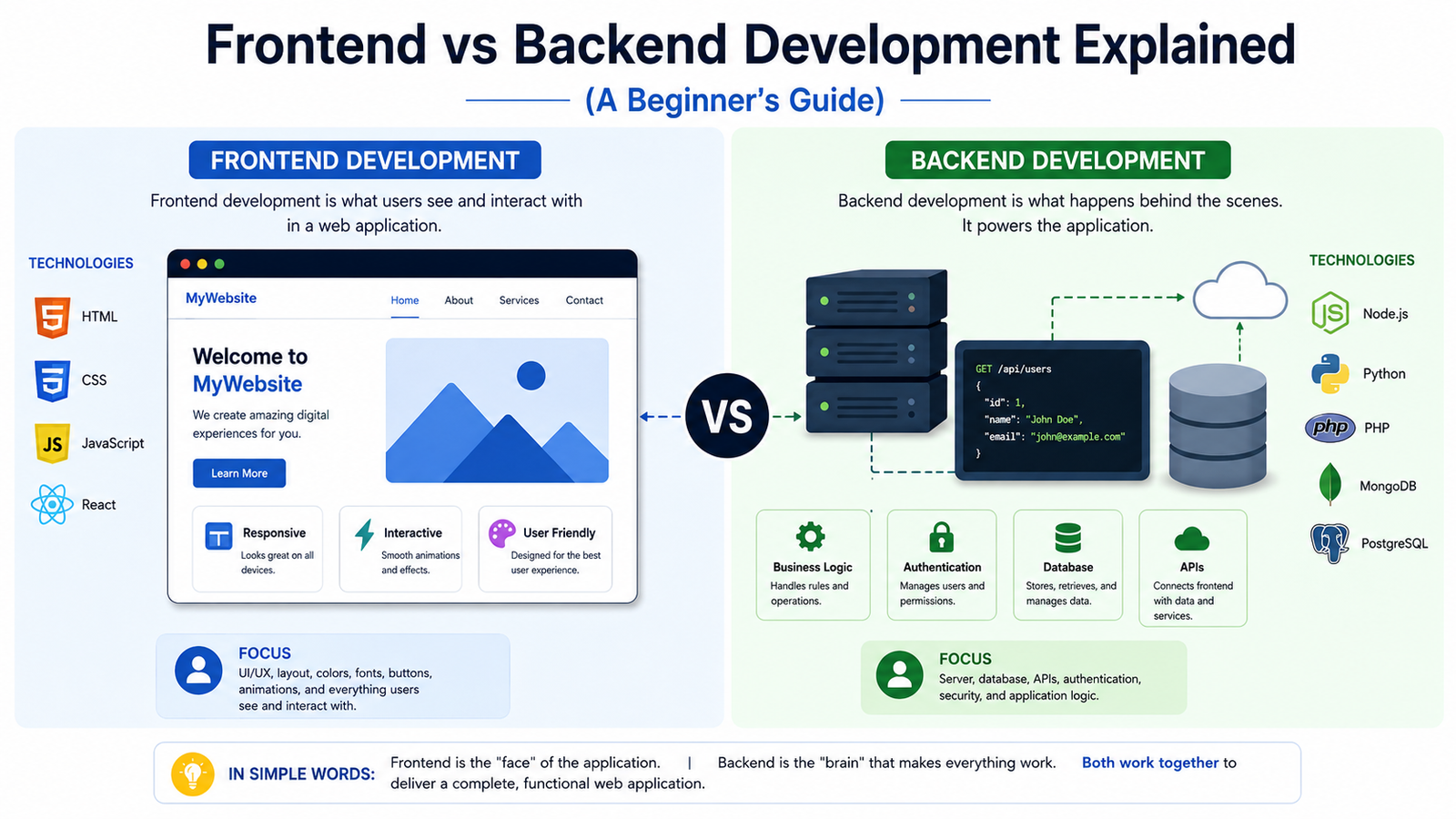
Frontend vs Backend Development Explained (A Beginner's Guide)
If you've ever Googled "how to become a web developer" and ended up more confused than when you started - yeah, that's a rite of passage. Everyone throws around terms like frontend, backend, full-stack... and nobody really stops to explain what they actually mean in plain English.
So let's fix that.
First, Think of a Restaurant
Seriously, bear with me here.
When you walk into a restaurant, you see the dining area - the tables, the menus, the lighting, the way the waiter smiles at you. That's the frontend. It's everything you interact with.
But behind that kitchen door? There's a whole system running - chefs, inventory, orders flying in, recipes being followed. That's the backend. You never see it, but if it breaks, your food never arrives.
A website works the same way.
What Is Frontend Development?
Frontend is everything that happens in your browser. The buttons you press, the animations that run, the form you enter your email in, all of that is frontend.
Frontend developers use three core technologies:
HTML is the structure. Think of it like the skeleton of a webpage, it tells the browser "put a heading here, an image there."
CSS is the styling. It's what makes things look good (or terrible, if you've seen websites from 2003).
JavaScript is the behavior. It makes things do something. Like showing a dropdown when you click , or updating a cart without reloading the page.
Today most front-end developers are also working with frameworks like React, Vue or Angular. These are basically tools that make building complex UIs way faster and cleaner. React especially has become almost synonymous with modern frontend work.
What Is Backend Development?
Backend is everything happening on the server, the part users never see but absolutely depend on.
When you log into Instagram, there’s got to be some logic that’s checking your password is correct, pulling your feed, deciding what posts to show you first. That logic lives in the backend.
Backend developers typically work with:
- Server-side languages like Node.js, Python, PHP, Ruby, or Java
- Databases like MySQL, PostgreSQL, or MongoDB basically where all the data lives
- APIs which are the messengers between frontend and backend (more on this in a second)
Here's a simple example: you type a movie name on Netflix and hit search. Your browser (frontend) sends that search to Netflix's servers (backend). The backend goes to the database, finds matching results, and sends them back. The frontend then displays those results nicely on your screen.
The whole thing happens in milliseconds. Wild, right?
What's an API and Why Does Everyone Keep Mentioning It?
An API (Application Programming Interface) is basically a waiter, it carries your request from the frontend to the backend and brings the response back.
When you use "Sign in with Google" on some random website, that website is using Google's API to handle authentication. The frontend sends a request, Google's backend checks your credentials, and the result comes back. You never had to create a new account.
APIs are everywhere once you start noticing them.
The Difference in Skills and Mindset
Frontend developers tend to be more design-aware. They care about how things look and feel. Pixel precision, animations, responsiveness on mobile vs. desktop that stuff matters a lot in frontend work.
Backend developers are more systems-focused. They think about efficiency, security, how to structure a database, how to handle 10,000 users hitting the server at the same time.
Neither is harder than the other, they're just different kinds of thinking.
So What About Full-Stack?
Full-stack developers work on both. They can build the UI and also set up the server and database.
Sounds impressive, and it is. But here's the honest truth: most full-stack devs have a stronger side. Someone might be 70% frontend and 30% backend, or vice versa. Very few people are genuinely excellent at both equally. That's just reality.
If you're just starting out, don't pressure yourself to learn everything at once. Pick one side, get decent at it, and expand from there.
Which One Should You Learn First?
Honestly? Frontend, almost always.
Here's why:
You get visual feedback immediately. You write some HTML, open a browser, and see something. That instant gratification keeps beginners motivated. With the backend, you're often staring at terminal outputs and database tables for a while before anything "visible" happens.
Frontend also has a lower barrier to entry. You need a browser and a text editor. That's it. No server setup, no environment configurations.
Once you understand how web pages are built and how JavaScript works, backend concepts become way easier to grasp, because you understand what the backend is actually serving.
A Real-World Breakdown
Let's say you're building a simple blog website.
Frontend handles:
- The homepage layout
- How individual blog posts look
- The navigation menu
- A comment form at the bottom of posts
Backend handles:
- Storing all the blog posts in a database
- Pulling the right post when someone clicks a link
- Saving new comments when users submit them
- User login so only you can publish posts
See how they complement each other? One without the other doesn't really work.
Common Misconceptions Worth Clearing Up
"Frontend is easy, backend is the real programming." Nope. Frontend JavaScript can get incredibly complex - state management, performance optimization, browser compatibility. It's not just making things pretty.
"You need to know both to get a job." Also not true. Companies hire dedicated frontend engineers and dedicated backend engineers all the time. Full-stack roles exist too, but specialization is totally valid.
"You have to learn a framework right away." Please don't. Learn vanilla HTML, CSS, and JavaScript first. Frameworks make much more sense once you understand what problems they're solving.
Where to Start Learning
If you want to start today, honestly just go to freeCodeCamp or The Odin Project. Both are free, structured, and actually good. MDN Web Docs (Mozilla's documentation) is your best friend for reference.
Don't buy a $200 course before you know if you even enjoy this stuff. Start free, see how it feels.
FAQ
1. Can I become a web developer without learning both?
Yes. Plenty of developers specialize in just frontend or just backend and have long, successful careers. You don't have to know everything.
2. Which pays more, frontend or backend?
Backend roles typically pay slightly higher on average, but the gap has narrowed. Senior front-end developers, especially those who know React deeply, earn very well. Location and company matter more than which side you pick.
3. How long does it take to learn frontend development?
Realistically, 3-6 months of consistent learning to get job-ready for a junior role. That means building actual projects, not just watching tutorials.
4. Do I need a computer science degree?
No. A lot of working developers are self-taught or went through bootcamps. What matters is your portfolio and what you can actually build.
5. What's the difference between a backend and a database?
A database is where the data is stored . The backend is the code that talks to the database , decides what to save, what to fetch, what to delete. They work together but they're not the same thing.
The Bottom Line
Frontend = what users see and interact with. Backend = the logic, data, and systems making everything work behind the scenes.
Neither is better. Both are necessary. And understanding the difference is the first real step toward figuring out where you want to go in web development.
Start with one side. Build something small. Break it. Fix it. That's genuinely how most developers learned, not from perfectly reading documentation, but from building stuff that didn't work and figuring out why.
Good luck. You've got this.