


Ladybird Browser: The Open‑Source Project Challenging Chrome's Dominance
- In this article
- What is Ladybird?
- Why does it matter?
- Security: the clean-slate advantage
- Where things stand today
- Should you be excited?
- FAQ
Let's be honest, most of us don't think much about our browser. You open it, type something, and the internet appears. Chrome works. It's everywhere. Even if you've heard it gobbles RAM and sends data back to Google, it's still the default for something like 65% of the world's web users. That's an almost absurd monopoly for a single piece of software.
So when a small, independent team announced they were building a brand-new browser, not a fork of Chrome, not a reskin of Firefox, but something written completely from scratch, the tech world sat up and paid attention. That browser is Ladybird, and it's quietly becoming one of the most exciting open-source projects in years.
What exactly is Ladybird?
Ladybird started its life as the built-in browser for SerenityOS, a hobby operating system built by Andreas Kling and a community of contributors. SerenityOS was itself a passion project, an attempt to build a clean, Unix-like OS from scratch just for the joy of engineering. Ladybird was its browser component, and it was, frankly, a fun side experiment.
Then in 2022, Kling spun Ladybird off into its own standalone project. By mid-2024, the Ladybird Browser Initiative was registered as an independent non-profit, with the explicit goal of building a truly independent, cross-platform browser that could run on Linux and macOS (and eventually more).
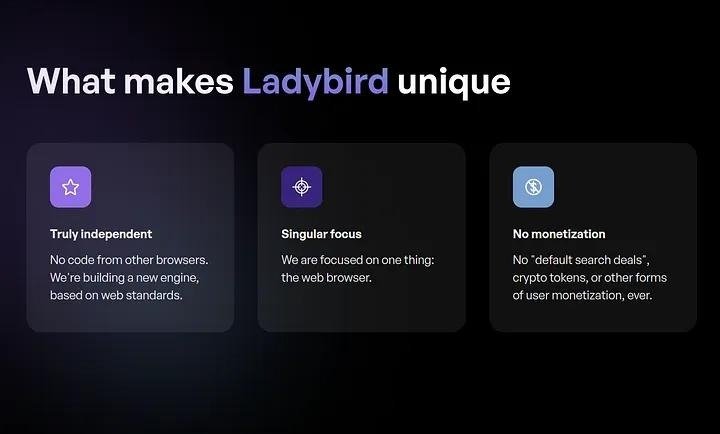
THE KEY PROMISE: No Chromium. No Gecko. No WebKit. Every component the JavaScript engine (LibJS), the HTML parser, the CSS engine, the networking stack written fresh by the Ladybird team.
That's either audaciously ambitious or completely reckless, depending on who you ask. Building a browser engine is one of the hardest engineering challenges in software. The web has decades of quirks, hacks, and edge cases baked in. But the Ladybird team isn't deterred and they've attracted serious attention as a result.
Why does it even matter?
You might be wondering: why does the world need another browser? Fair question. Here's the uncomfortable truth about where we are in 2026: the web runs on Chromium. Chrome uses it. Edge uses it. Brave uses it. Opera uses it. Even Samsung's browser uses it. When one rendering engine touches this much of the internet, it's not really an open web anymore, it's Google's web, with a thin veneer of competition.
Mozilla's Firefox, running on the Gecko engine, is the last major independent browser engine and Firefox's market share has been shrinking for years. Safari runs on WebKit, which Apple controls and largely develops for its own ecosystem. If Firefox ever folds or loses momentum, we'd be down to one company effectively setting web standards through sheer browser dominance.
- ~65% Chrome's global market share
- 3 Major rendering engines left
- 100% Ladybird code written from scratch
Ladybird isn't trying to take 30% market share by next Tuesday. Its goal is more fundamental: prove that an independent, community-built browser engine is possible, and keep genuine diversity alive on the web. That matters for everyone - developers, users, and anyone who cares about the internet not being owned by a single corporation.
Security: the clean-slate advantage
Here's where things get genuinely interesting, especially if you care about your privacy and security online.
SECURITY CONSIDERATIONS WORTH KNOWING
- No inherited legacy vulnerabilities. Chromium and Gecko carry years of accumulated code, some of it old, some of it patched over patches. Ladybird starts clean. There's no legacy attack surface brought in from a decade-old codebase.
- New codebase, new unknown bugs. To be fair: starting fresh also means new code that hasn't been battle-tested. Ladybird will have its own bugs, some potentially serious that years of fuzzing and real-world use haven't found yet.
- No built-in telemetry by design. Chrome's data collection is well-documented. Ladybird, as a non-profit open-source project, has no business model built around harvesting user data. The code is public; anyone can audit what it sends (or doesn't).
- Open-source security model. More eyes on the code means vulnerabilities get spotted and disclosed more openly. There's no corporate incentive to quietly patch something embarrassing.
- Still a work in progress. The team is explicit that Ladybird is not ready for everyday browsing yet. Using it as your primary browser today would be premature from a security standpoint; it's missing hardening features that mature browsers have developed over years.
The honest take on security is nuanced. A clean codebase is a genuine advantage in principle; you're not dragging in forgotten code from 2009 that nobody fully understands anymore. But maturity matters too. Chrome and Firefox have had thousands of security researchers picking them apart. Ladybird hasn't. That gap will close over time, but it's real right now.
For privacy-conscious users, the lack of a data-monetization business model is perhaps the biggest security win. Ladybird doesn't have advertisers to serve. It doesn't need to know where you go online. That structural difference is harder to fake than any feature.
Where things stand today
As of 2026, Ladybird can render a significant portion of the web. The team has been making steady progress on web standards compliance running against tests like WPT (Web Platform Tests) to measure how well it handles the actual specifications browsers are supposed to implement. Results are genuinely promising for a project at this stage.
The JavaScript engine, LibJS, handles a solid chunk of modern JS. CSS support has improved dramatically. Basic navigation, forms, and many popular websites work. But calling it ready for daily use would be generous. Complex web apps, WebAssembly-heavy sites, some modern CSS layouts there are gaps, and the team is open about them.
Funding-wise, the non-profit model has attracted meaningful donations. Notably, GitHub co-founder Chris Wanstrath contributed $1 million to the project, a signal that serious people in tech believe in what Ladybird is trying to do. The team has grown from a handful of volunteers to a small group of paid engineers dedicated to the project full-time.
Should you be excited?
Yes, but with patience. Ladybird is genuinely important as an idea and as a project, even if it won't replace Chrome in your dock anytime soon. What it represents matters: the possibility that the web's infrastructure doesn't have to be controlled by whoever has the biggest engineering budget.
If you're a developer, keep an eye on it. If you care about open source, consider donating or following the project. And if you're the kind of person who likes kicking the tires on interesting software, Ladybird builds are available on Linux and macOS right now.
Just don't use it to file your taxes yet.
Frequently asked questions
- Is Ladybird available to download and use right now?
Yes, development builds are available for Linux and macOS. However, the team strongly advises that it's not ready for daily use, it's missing features, has known bugs, and hasn't been security-hardened for real-world browsing. It's best treated as a preview for developers and enthusiasts at this stage.
- Who is building Ladybird and how is it funded?
Ladybird is developed by the Ladybird Browser Initiative, a registered non-profit. It grew out of Andreas Kling's SerenityOS project and is now maintained by a small team of paid engineers plus open-source contributors. Funding comes from donations notably a $1 million contribution from GitHub co-founder Chris Wanstrath rather than advertising or data monetization.
- How is Ladybird different from Brave or Firefox?
Brave is built on Chromium, it's essentially Chrome with a privacy layer on top. Firefox runs on Mozilla's Gecko engine. Ladybird uses no existing browser engine at all; its HTML parser, CSS engine, JavaScript engine, and networking stack are all written from scratch. That's the key distinction, it's architecturally independent in a way that Brave or Edge simply aren't.
- Is Ladybird safe to use from a privacy standpoint?
In principle, Ladybird's non-profit structure and fully open-source codebase mean there's no built-in data collection or advertising pipeline. In practice, it's too early to use it for sensitive browsing, not because of privacy concerns, but because it's an immature browser with incomplete security hardening. The privacy fundamentals are solid; the security maturity is still catching up.
- When will Ladybird be ready for everyday use?
The team hasn't committed to a hard launch date, which is actually a good sign, they're being realistic rather than overpromising. Most estimates in the community suggest a usable alpha for general users is still a couple of years away. The focus right now is on web standards compliance and core stability before tackling performance and the full feature set everyday users expect.
The web is better when it's built by many, not owned by one. Ladybird is a bet on that idea.