


API Integration Services: When Should Your Business Hire a Professional Team?
Postman’s 2025 State of the API Report found that 83.2% of respondents had adopted some level of API-first development. APIs stopped being a side task a while ago. They sit behind almost every checkout, login and dashboard your customers touch. Yet plenty of businesses still hand integration to whoever on the team “knows a bit of code.” That works until a payment provider changes its authentication rules on a Friday evening. If you’ve ever worked with a website development company, you know how fast a small connector turns into a maintenance headache. This post covers the point where bringing in a professional API integration team stops being optional.
What Is API Integration (and What Does It Cover)?
API integration services connect two or more software systems so they share data automatically, with nobody copying numbers between spreadsheets. A professional engagement usually includes:
- Mapping which systems need to talk and what data moves between them
- Building and testing connectors for CRMs, payment gateways, ERPs, shipping and messaging tools
- Authentication, rate limits and error handling
- Documentation and monitoring after launch
- Updates when a third-party API changes
Why Businesses Hand Integration to a Professional Team
Most businesses don’t outsource because they can’t code. They outsource because a bad integration costs money in places nobody budgeted for. Good software development services treat integration as real engineering, with owners, tests and a maintenance plan.
- Fewer failed orders, duplicate records and sync gaps
- New tools go live without breaking existing ones
- Security handled up front: tokens, encryption, permission scopes
- Your own developers stay on product work
- A documented setup that someone else can pick up later
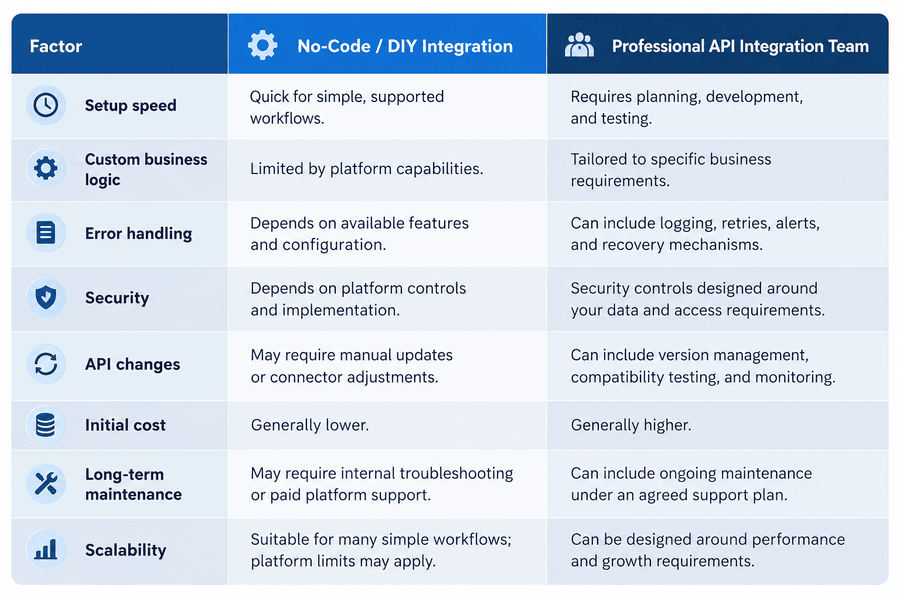
No-Code Connectors vs a Professional Team
Signs It’s Time to Call in Help
My rough rule: if the integration touches money, customer data or more than two systems, stop improvising.
- You’re connecting three or more systems, not two
- Data errors are reaching customers, invoices or reports
- Someone spends hours every week on manual exports as a “temporary” fix
- Payments, health records or personal data are involved
- The person who built the integration has left, or is about to
Mittal Technologies Insight: Ask who owns the integration after launch. If the answer is “nobody in particular,” that’s the real risk, not the code.
Mobile App Development Services and API Integration
Apps expose weak integrations faster than websites do. Users are on patchy networks, and every slow response feels like a crash. Teams offering mobile app development services usually design the API layer and the app together, which saves a lot of rework.
- Push notifications and in-app messaging through third-party providers
- Payment and wallet integrations with proper token handling
- Offline-friendly sync so data survives a weak signal
- Maps, delivery tracking and location services
- Login through Google or Apple with correct permission scopes
- Backend links to inventory, CRM or ERP systems
When You Probably Don’t Need a Team
Professional help isn’t always the answer, and anyone who says otherwise is selling something.
- A single, low-risk link, like a contact form feeding a mailing list
- A short-lived campaign tool that will be retired in a few months
- An internal prototype with no real customer data
- Your in-house developers have built the same integration before and have the time
How a Professional Integration Project Runs
- Audit the systems and list every data flow in plain language first.
- Read the API documentation and flag rate limits, auth methods and deprecation dates.
- Design the data mapping and error paths before any code is written.
- Build in a sandbox with test data only.
- Break things on purpose: timeouts, bad payloads, expired tokens.
- Launch in stages with monitoring and alerts switched on.
- Hand over documentation and a maintenance plan.
Mittal Technologies Insight: Step five gets skipped most often, and it’s the one that saves your weekends.
Challenges and Best Practices
- Patchy documentation. Postman’s 2024 State of the API Report found 39% of respondents call inconsistent docs their biggest roadblock. Best Practice: test against a sandbox early and keep your own integration notes.
- Third-party API changes. Best Practice: pin versions, follow changelogs and monitor for deprecation notices.
- Security gaps. Best Practice: least-privilege scopes, regular key rotation, secrets stored outside the codebase.
- Rate limits and slow responses. Best Practice: queue requests, cache data that rarely changes, retry with backoff.
- Data mismatches between systems. Best Practice: agree on one source of truth for each field before building.
Where API Integration Is Heading
- More APIs built for AI agents, not only human developers. Postman’s 2025 report found roughly one in four teams already do this.
- Standard protocols, such as the Model Context Protocol, for connecting tools and AI systems
- Event-driven updates replacing nightly batch syncs
- Monitoring and governance treated as a requirement, not an extra
Wrapping Up
API integration is cheap to start and expensive to repair, so the useful question is who owns it once it’s live. If you’re weighing a build, talk to our team about your systems before the first connector gets written.
FAQs
1. What are API integration services?
They connect separate software systems so data moves between them automatically, including design, build, testing, security and ongoing maintenance.
2. When should a business hire a professional API integration team?
When the integration involves payments or personal data, links three or more systems, or has already caused data errors or downtime.
3. How long does an API integration take?
A single, well-documented API can take days. Multi-system projects with custom logic often take several weeks or more, depending on documentation quality and testing needs.
4. How much do API integration services cost?
It depends on the number of systems, the quality of their documentation, custom logic and security requirements. A scoped audit gives a far more reliable figure than a generic estimate.
5. Can existing systems be integrated without a rebuild?
Usually, yes, through middleware or an adapter layer. Very old systems with no API at all may need extra work first.